
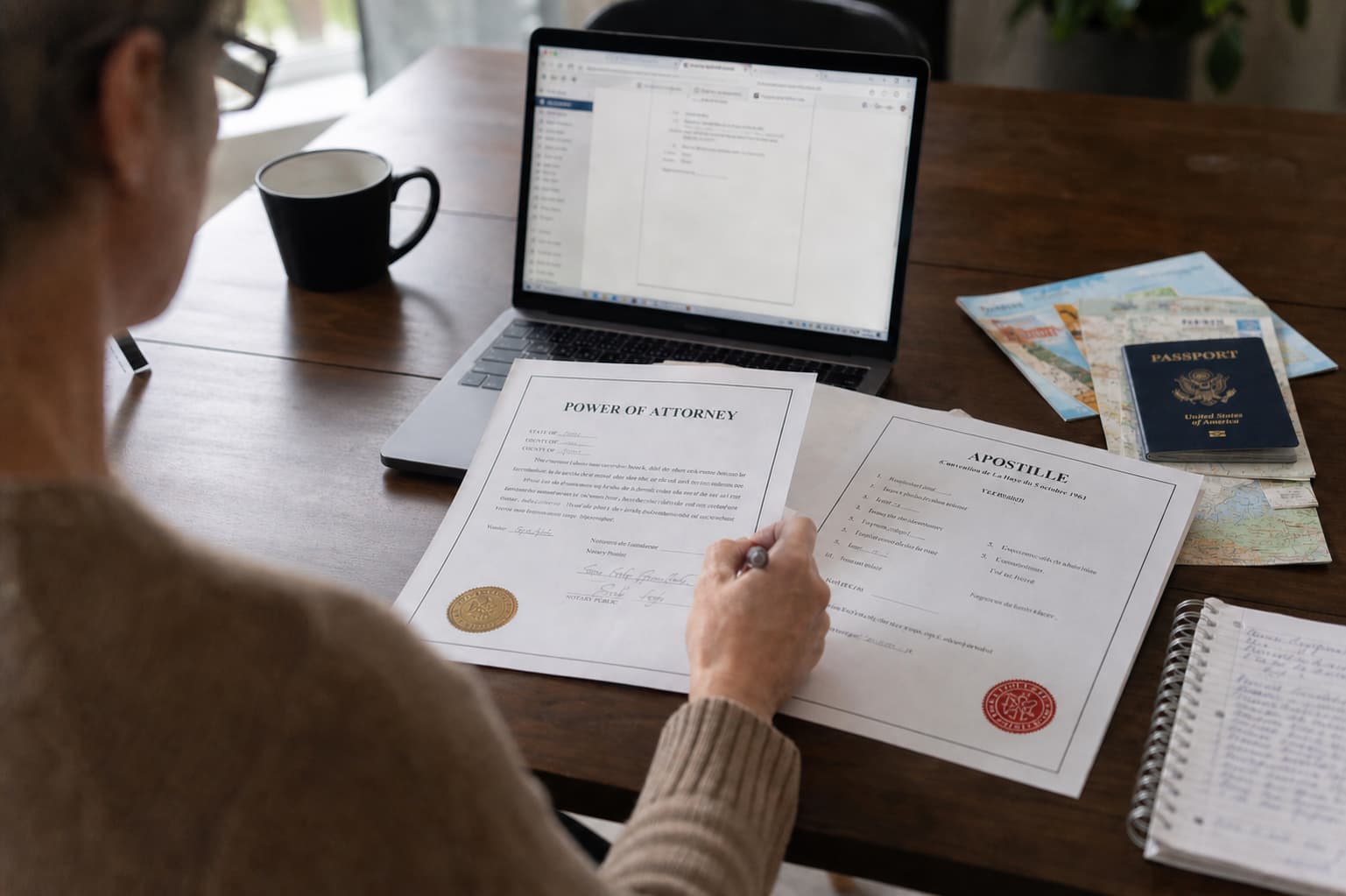
Power of Attorney documents used internationally require notarization followed by Apostille certification. Requirements vary by destination country – some need only Apostille while others demand certified translations, embassy authentication, or specific PoA types.
NotaryPublic24 streamlines both processes, delivering authenticated PoA documents within 24 hours.
Introduction
A Power of Attorney (PoA) is a powerful document that grants legal authority to act on someone’s behalf.
When that authority extends internationally – whether for property transactions, banking matters, or legal representation abroad – the document requires notarization and Apostille certification. Without proper authentication, foreign authorities may refuse to recognise your authority, jeopardising your transaction.
This guide explains when a Power of Attorney needs Apostille certification, the specific process, country-specific requirements, and how NotaryPublic24 streamlines the combined notarization and Apostille process.
When Does a Power of Attorney Require an Apostille?
A Power of Attorney used domestically within the UK typically doesn’t require Apostille certification. However, the moment your PoA will be used internationally – presented to foreign banks, property authorities, or legal entities – Apostille becomes essential.
Common scenarios requiring Apostille for Power of Attorney:
- Managing or transferring property in another country
- Operating bank accounts or financial accounts abroad
- Representing yourself or others in legal matters overseas
- Authorising someone to make healthcare decisions internationally
- Granting business authority to representatives in other jurisdictions
- Managing inheritance or estate matters with international components
- Tax matters requiring representation in foreign tax authorities
Foreign authorities specifically require Apostille certification because it provides independent verification that the document is genuine and that you legitimately authorised the person acting on your behalf.
Without Apostille, institutions may question document authenticity or refuse to honour the PoA entirely.
The Power of Attorney Notarization Process
Before seeking Apostille, your Power of Attorney must be notarized.
The Notary Public witnesses the document’s execution and certifies that you – the document creator – understand what you’re signing and are doing so freely. Notarization establishes:
- Your identity is verified and confirmed
- You understand the authority you’re granting
- You’re signing freely without coercion
- The signature is genuinely yours
- The person receiving authority is correctly identified
The Notary doesn’t assess whether granting the authority is wise – that’s your decision.
They simply confirm that the signature and circumstances are genuine. This impartiality is crucial; it means foreign authorities trust that the certification isn’t biased. At NotaryPublic24, we specialise in Power of Attorney notarization.
Our process involves uploading your PoA, verifying your identity through secure biometric authentication, and having our qualified Notary Public witness and certify the document.
The Apostille Process for Power of Attorney
Once notarized, your Power of Attorney is ready for Apostille.
The Apostille is a certificate issued by the FCDO confirming that the Notary Public’s signature is genuine. The Apostille process involves:
- Submitting your notarized Power of Attorney to the FCDO
- The FCDO verifies the Notary Public’s credentials and signature
- An official Apostille certificate is issued and attached to your document
- The Apostille contains fields documenting the Notary, the date, and the FCDO seal
Importantly, notarization and Apostille are sequential.
You cannot obtain an Apostille without first having the document notarized. This two-step process ensures that foreign authorities have complete confidence in the document’s authenticity. NotaryPublic24 combines both services. We notarize your Power of Attorney and immediately submit it for Apostille, delivering both authentications within 24 hours.
This integration eliminates the delays and complexity of managing two separate processes.
Types of Power of Attorney Requiring Apostille
Not all PoA types share identical international requirements, though all may require Apostille in certain jurisdictions:
- General Power of Attorney – Grants broad authority across multiple areas.
These frequently require Apostille when used internationally because their broad scope necessitates strong authentication.
- Limited or Special Power of Attorney – Restricts authority to specific actions (e.g., selling a property, managing bank accounts).
Often Apostille is essential because the specificity makes verification more critical.
- Lasting Power of Attorney – Designed for incapacity planning, particularly for healthcare and financial decisions. Many countries specifically require Apostille for lasting PoA to ensure the authority is legitimate and current.
- Enduring Power of Attorney – Remains effective even if the creator becomes incapacitated. International use frequently requires Apostille to confirm the authority’s validity.
- Durable Power of Attorney – Survives the creator’s incapacity.
Similar to enduring PoA, international jurisdictions often mandate Apostille.
Regardless of the PoA type, if it will be used internationally, assume Apostille is required unless your destination country specifically states otherwise.
It’s safer to obtain unnecessary Apostille than to have documents rejected for lacking certification.
Country-Specific Power of Attorney Requirements
Different countries have specific requirements for Power of Attorney authentication. Understanding your destination country’s rules prevents delays and complications.
- Spain – Spanish authorities require notarized and Apostille-certified PoA. They may also require a certified Spanish translation. If the PoA involves property, the Spanish notary (notario) must also acknowledge the Apostille, creating an additional step.
- United Arab Emirates – The UAE requires Apostille on all foreign PoA documents. Additionally, the document must be authenticated by the UAE embassy or consulate in the UK. The sequence is critical: notarization, then Apostille, then embassy authentication.
- United States – Requirements vary by state. Some US states accept Apostille alone; others require certification by the state where the PoA will be used. Federal matters typically require additional federal authority verification beyond Apostille.
- Australia – Australian authorities accept Apostille-certified PoA but increasingly require e-Apostille for modern digital handling. If the PoA grants financial authority, additional declarations may be necessary.
- France – The French legal system has specific PoA requirements.
A notarized and Apostille-certified UK PoA may be accepted, but the French notary reviewing it may request modifications to match French conventions.
- Canada – Generally accepts Apostille-certified PoA, but provincial requirements vary.
Check the specific province where the PoA will be used.
For any international PoA, contact the destination country’s embassy, consulate, or legal authority before proceeding. Requirements change frequently, and confirmation ensures you complete all necessary steps.
Common Issues and How to Avoid Them
Power of Attorney authentication frequently encounters preventable issues. Understanding these problems helps you avoid delays:
- Incomplete or illegible documents – Foreign authorities refuse unclear PoA documents.
Ensure your PoA is complete, clearly printed, and easy to read before notarization.
NotaryPublic24 reviews documents for clarity before notarizing, preventing this issue. - Wrong PoA type – You must use the correct PoA type for your jurisdiction.
Using a General PoA where a Lasting PoA is required causes rejection. Confirm the correct type with the destination country before drafting.
- Missing required declarations – Some countries require specific declarations or statements within the PoA text.
Missing these provisions causes rejection even if the PoA is notarized and Apostille-certified. Research requirements thoroughly.
- Outdated signatures – If you’re using an existing PoA that’s years old, some jurisdictions question its current validity.
Obtaining a fresh notarization with current dating reassures foreign authorities.
- Incorrect translation – If translation is required, use a professional translator. Courts reject PoA documents with poor translations, even if notarized and Apostille-certified.
- Missing FCDO verification – Occasionally, Apostilles are issued but not properly verified. The FCDO maintains a register; foreign authorities sometimes verify the Apostille number. Ensure your certificate number is recorded correctly.
NotaryPublic24 prevents these issues through careful document review, proper sequencing of notarization and Apostille, and guidance on country-specific requirements.
NotaryPublic24’s Combined Power of Attorney Service
NotaryPublic24 offers an integrated service specifically for Power of Attorney documents.
Rather than managing notarization and Apostille separately, we handle both seamlessly. Our service includes:
- Initial document review to ensure compliance with destination country requirements
- Guidance on which PoA type your jurisdiction requires
- Secure identity verification through biometric authentication
- Qualified Notary Public notarization within 24 hours
- Immediate FCDO Apostille submission
- Paper or e-Apostille options based on your destination country
- Delivery of fully authenticated documents within 24 hours of FCDO approval
For international Power of Attorney matters – whether for property, banking, healthcare, or legal representation – NotaryPublic24 provides the expertise and efficiency that complex international documents demand.
Preparing Your Power of Attorney for Notarization
Proper preparation ensures smooth notarization and Apostille:
- Draft your Power of Attorney carefully, ensuring it addresses the specific authority you wish to grant.
Generic templates may not suit your situation, that’s why we offer customizable Power of Attorney Forms.
- Verify the destination country’s specific requirements – does it require a particular PoA type?
Specific declarations? Minimum or maximum authority scopes? Research thoroughly before finalising your draft.
- Have your document professionally formatted and printed clearly. Avoid handwriting except for necessary signatures. Poor presentation causes Notaries to request clarification.
- Ensure all names are consistent throughout the document – yours, the attorney-in-fact, and any other parties referenced must be spelled identically.
- Gather valid identification before your notarization appointment. Passport or UK driving licence is required.
Consider bringing a trusted advisor if the PoA involves complex authority or if English isn’t your first language. This demonstrates capacity and prevents misunderstandings. NotaryPublic24’s online process allows you to upload or create your PoA.
Our team identifies any issues before notarization, ensuring your document meets all requirements.
How NotaryPublic24 Works
NotaryPublic24 streamlines Power of Attorney notarization and Apostille into one seamless process:
- Upload or create your Power of Attorney document with details about its intended international use
- We review your PoA for destination country compliance and advise on any necessary adjustments
- Complete secure biometric identity verification to confirm you’re the document creator
- Our qualified Notary Public notarizes your PoA and immediately submits for Apostille
- Receive your notarized and Apostille-certified Power of Attorney, ready for international use, within 24 hours
A notarized and Apostilled power of attorney is also what a representative needs to request your NIE or submit a Spain digital nomad visa application on your behalf.
Frequently Asked Questions
Do all countries require Apostille for Power of Attorney?
Most countries require Apostille for international PoA, but requirements vary. Some jurisdictions may have additional requirements beyond Apostille, such as embassy authentication or certified translations. Always verify your specific destination country’s requirements before proceeding.
Can I use an existing Power of Attorney or do I need to create a new one?
You can use an existing PoA if it’s still valid and addresses your current needs.
However, if the document is several years old, obtaining fresh notarization with current dating reassures foreign authorities of its continued validity. Very old PoA documents may be questioned regardless of authentication.
What’s the difference between General and Limited Power of Attorney for international use?
General PoA grants broad authority across multiple areas; Limited PoA restricts authority to specific actions. Both require Apostille for international use.
Your destination country may have preferences – some require Limited PoA for specific transactions, whilst others accept General PoA. Check jurisdiction-specific requirements.
Do I need the recipient (attorney-in-fact) present for notarization?
Not necessarily. The Notary Public witnesses your signature, not the recipient’s. However, some jurisdictions require the recipient’s acknowledgement. NotaryPublic24 guides you on whether your destination country requires the recipient’s involvement or signature.
What happens if a country doesn’t recognise my Apostille-certified PoA?
This typically indicates missing country-specific requirements beyond Apostille – perhaps a required translation, embassy authentication, or specific PoA language. Contact the destination country’s authority to understand what’s needed.
Additional authentication may be required beyond Apostille.
Can I modify my Power of Attorney after it’s notarized and Apostille-certified?
Once notarized and Apostille-certified, modifying the document invalidates both certifications. Any changes require a new notarization and Apostille.
This is why proper preparation before notarization is critical – changes afterwards are time-consuming and costly.
Final Thoughts
Power of Attorney documents used internationally demand careful authentication through notarization and Apostille.
This two-step process ensures foreign authorities recognise your authority legitimately. Different countries have specific requirements – some accept standard Apostille whilst others demand additional certification, translation, or embassy acknowledgement. By understanding when Apostille is required, which PoA type your jurisdiction demands, and the specific authentication steps needed, you avoid delays and rejections.
NotaryPublic24’s integrated Power of Attorney service combines notarization and Apostille, delivering authenticated documents within 24 hours. Whether you’re managing property abroad, authorising financial decisions internationally, or granting legal representation overseas, let NotaryPublic24 handle your Power of Attorney authentication.