
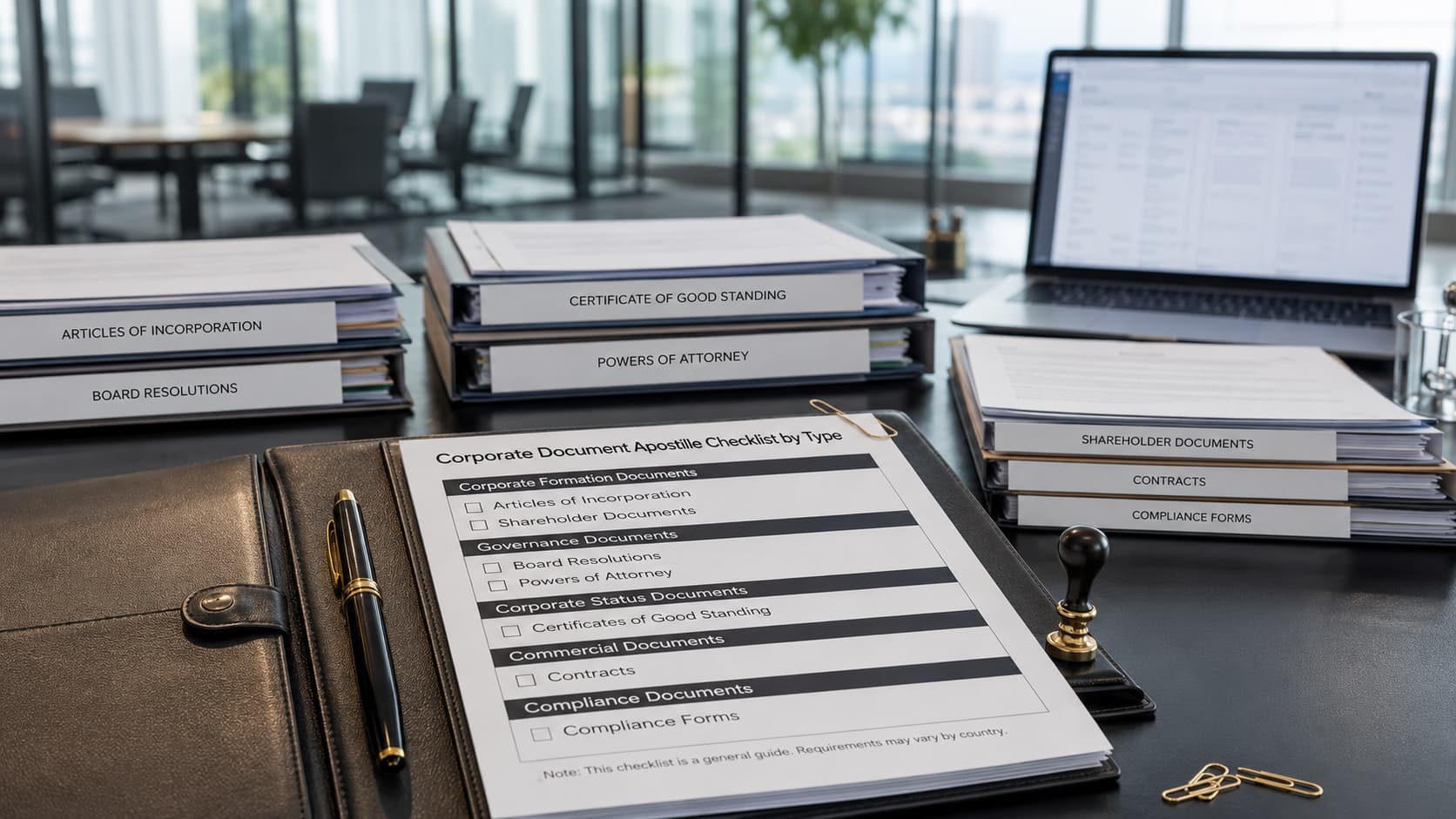
Corporate Document Apostille Checklist: M&A, Board Resolutions, Articles of Incorporation, and More
When a corporate transaction crosses borders – a subsidiary acquisition, a foreign branch registration, a tender for an international contract, an opening of a bank account abroad – the legal team usually hits the same bottleneck: which documents need to be apostilled, in what order, and what does each receiver actually want? This is a practical, document-by-document checklist for the most common corporate document Apostille scenarios. It is built for in-house counsel, company secretaries, and corporate paralegals who need a clear answer per document type, not a general “what is an Apostille” explainer. For background on the Apostille system itself, see our Apostille services hub. For the wider business documents workflow, see for business.
Quick Reference: Common Corporate Documents
| Document | Notarize first? | Original or copy? | Typical freshness required | Urgency |
|---|---|---|---|---|
| Articles of Incorporation / Memorandum & Articles | Yes (certified copy) | Certified copy | 6–12 months | Medium |
| Certificate of Incorporation | No (already an official record) | Original from Companies House | 3–6 months | Medium |
| Certificate of Good Standing | No | Original | Under 3 months | High |
| Board Resolutions | Yes | Notarized copy | Match transaction date | High |
| Power of Attorney (corporate) | Yes | Notarized original | Under 3–6 months | High |
| Shareholder Register / Share Certificates | Yes (certified copy) | Certified copy | 3–6 months | Medium |
| Beneficial Ownership Declaration | Yes | Notarized original | Under 3 months | High |
| Tax Residency Certificate | No | Original from HMRC | Tax year specific | High |
| Commercial Contracts / Agreements | Yes (signature notarization) | Notarized original | At signing | High |
| Bank Reference Letters | Yes (signature notarization) | Notarized original | Under 1 month (banks) | Medium |
| Audited Financial Statements | Yes (certified copy) | Certified copy | Latest filing | Medium |
| Trademark / Patent Registrations | No | Certified copy from IPO | No window | Low |
Other governance documents – such as a shareholders agreement or an LLC operating agreement – often require the same notarization and Apostille process before they are accepted abroad.
The pattern: documents issued by a government body (Companies House, HMRC, the IPO, courts) usually do not need prior notarization – they are already official records. Documents created internally (board resolutions, shareholder registers, commercial contracts) need notarization first because there is no public authority that issued them.
UK-to-EU Filings After Brexit
Post-Brexit, UK companies submitting documents into the EU now hit Apostille requirements that previously did not apply. Even routine filings – a branch registration in Germany, a property purchase in Spain, a VAT representative appointment in France – now expect apostilled UK documents in place of the pre-Brexit waiver. Two practical consequences:
- Volume is up. Many UK in-house teams that rarely needed Apostille before 2021 now process them in batches. Build a recurring Apostille relationship rather than treating each filing as a one-off.
- Sworn translation is now standard. Most EU receivers require a sworn translation alongside the Apostille (in Spain, France, Germany, Italy in particular). Order the translation in parallel with the FCDO step to avoid sequential delays.
For a related cross-border filing where Apostille on a Certificate of Free Sale is required, see our Certificate of Free Sale guide.
Mergers & Acquisitions
A typical M&A close involving a UK target and a foreign acquirer needs the following stack apostilled:
- Board resolution authorising the sale – notarized then apostilled
- Share purchase agreement signature pages – notarized then apostilled
- Shareholder approval certificates – notarized then apostilled
- Certificate of Good Standing for the seller entity – apostilled directly (no notarization)
- Articles of Association / Memorandum – certified copy first, then apostilled
- Power of Attorney from signatories who could not attend – notarized then apostilled
Order ahead. The full Apostille turnaround is typically 5–10 working days through NotaryPublic24, longer if FCDO is at capacity. For an M&A closing on a hard deadline, build at least three weeks of buffer into the timeline. If the destination is a non-Hague country (UAE, Saudi Arabia, China mainland), substitute Apostille with full Embassy legalization. The chain becomes: notarization → FCDO → destination Embassy in London → sometimes destination Ministry of Foreign Affairs. Plan four to six weeks instead of two.
Setting Up a Foreign Subsidiary
Opening a subsidiary in another jurisdiction typically requires:
- Certificate of Incorporation of the UK parent – apostilled
- Articles of Association – certified copy then apostilled
- Board resolution authorising the subsidiary’s incorporation – notarized then apostilled
- Power of Attorney appointing the local representative – notarized then apostilled, often with a sworn translation in the local language
- Certificate of Good Standing – fresh (within 3 months) and apostilled
- Beneficial ownership declaration – notarized then apostilled
- Tax residency certificate – from HMRC, apostilled directly
Most jurisdictions require the documents in a specific order and reject filings where the order is wrong. Confirm the local lawyer’s exact checklist before you start the Apostille chain.
Opening a Foreign Bank Account for the UK Entity
Bank account opening abroad is the most paperwork-intensive single corporate task. The standard pack:
- Certificate of Incorporation – apostilled (recent)
- Articles of Association – certified copy then apostilled
- Register of Directors / Officers – certified copy then apostilled
- Register of Members / Shareholders – certified copy then apostilled
- Certificate of Good Standing – within 3 months, apostilled
- Bank reference letter from your existing UK bank – notarized signature, then apostilled
- Beneficial ownership form (the bank’s own) – notarized signatures then apostilled
- Passports of all signatories and beneficial owners – certified copies then apostilled
- Proof of address for each signatory (utility bill or bank statement, certified copy) then apostilled
Some receiving banks accept digital Apostilles; most still want originals with wet stamps. Confirm before you order.
Tender Submissions and Public Procurement Abroad
When bidding on foreign government tenders or pre-qualifying with state-owned enterprises:
- Certificate of Incorporation – apostilled
- Certificate of Good Standing – apostilled (under 3 months)
- Tax clearance certificate from HMRC – apostilled
- Audited accounts for the last 3 years – certified copies then apostilled
- Power of Attorney for the bid signatory – notarized then apostilled
- Sworn statement on no conflicts of interest – notarized then apostilled
- Bid bond / performance bond paperwork – notarized then apostilled
Tender deadlines do not move. Order the full Apostille pack as soon as the RFP drops, not when you have a draft bid ready.
Patent, Trademark, and IP Filings
For international IP filings (national-phase entries from PCT, Madrid Protocol designations, foreign trademark registrations):
- Power of Attorney for the foreign agent – notarized then apostilled (in some countries the POA is the only document that needs Apostille; the rest of the file is handled by the agent)
- Assignment deeds between the inventor and the company – notarized then apostilled
- Declaration of inventorship – notarized then apostilled
- Certified copy of UK trademark or patent registration – apostilled
For US filings, USPTO does not require Apostille on most documents – plain certified copies usually suffice. For Brazil, Argentina, and most of Latin America, full Apostille is mandatory on POA and assignment. Confirm jurisdiction by jurisdiction.
How NotaryPublic24 Handles Corporate Apostille Batches
For high-volume corporate Apostille requirements, we manage full document packs in a single workflow:
- Submit your document list – we map each one to its required prior-step (notarization, certified copy, FCDO direct)
- We notarize all internal documents – board resolutions, POAs, signature pages, register copies – via our Notary Public team
- We coordinate Apostille submission to the FCDO for the entire pack
- We track and update you with milestone confirmations per document
- We courier the apostilled pack to your office or directly to the receiving authority abroad
Turnaround in practice: Notarization within 24 hours. Apostille typically within 24 hours from most jurisdictions – UK Apostille takes around 3 working days end-to-end due to FCDO processing. We confirm the exact timeline before you order. You can order corporate Apostille services online and bundle them with notarization in a single order. For documents not requiring Apostille, see also our Companies House document certification service. For an overview, see for business or our full service range.
What Slows Corporate Apostille Down (and How to Avoid It)
Out-of-date Certificates of Good Standing. Most destinations require under 3 months. Order fresh ones at the start of the Apostille process, not from your existing file. Missing signatures or wrong signatories. Board resolutions need to be signed by the authorised director under your Articles. Resolutions signed by a non-authorised person get rejected and the whole stack has to be re-notarized. Apostille on wrong layer. For Articles of Association, the Apostille goes on the certified copy from Companies House or a Notary’s certification – not the original print-out. Sending the wrong layer means a rejection at FCDO. Wrong destination assumption. Apostille only works for Hague Convention countries. UAE, Saudi Arabia, Qatar, mainland China, Vietnam, and a few others still require full Embassy legalization. Confirm before ordering. Translation timing. If the destination needs the documents in another language, decide whether the translation should be apostilled too. In Spain, France, Germany, and most civil-law countries, the translation needs a sworn translator in that country – arrange in parallel with the UK Apostille, not after. For more on translation, see our guide on sworn vs certified translation.
Frequently Asked Questions
Do I need to notarize a Certificate of Incorporation before apostilling it?
No. A Certificate of Incorporation issued by Companies House is already an official UK government record and can be apostilled directly. The same applies to Certificates of Good Standing and most Companies House registers. Notarization is required for internal company documents (board resolutions, POAs, signed declarations) that have no government-issued original.
How long does corporate Apostille take through NotaryPublic24?
Standard turnaround is 24 hours including notarization or 3 working days for a complete pack (notarization plus FCDO Apostille for the UK). Same-day notarization is available for urgent files. Plan for at least two weeks of buffer on M&A timelines and three to four weeks for non-Hague destinations requiring full Embassy legalization.
Can a single Apostille cover multiple documents?
No. The Apostille is applied per document. A bundle of ten board resolutions requires ten Apostilles. Some destinations accept a “bound packet” approach where multiple documents are stitched together and apostilled as a single set, but this requires advance approval from the receiving authority.
What if my destination country has not joined the Hague Convention?
Apostille is not enough. You need full Embassy legalization – the document is notarized, sent to the FCDO for legalization, then to the destination country’s Embassy in London for consular stamping. For UAE, China (mainland), Saudi Arabia, and Vietnam, this is the standard route. NotaryPublic24 manages the full chain on your behalf.
Do I need original documents or are certified copies enough?
For Articles of Association, registers, and certified copies of government records, certified copies are the working document – the Apostille goes on top of those. For board resolutions, POAs, and signed declarations, you need the original signed document; we notarize the original and apostille the notarized version. The destination authority’s instructions are the final word.
How fresh do corporate documents need to be?
Most destinations want the Apostille issued within the last three months. The underlying document’s age depends on its type: Certificates of Good Standing usually need to be under three months; Articles of Association can be older as long as the company has not amended them; board resolutions should match the transaction date.