
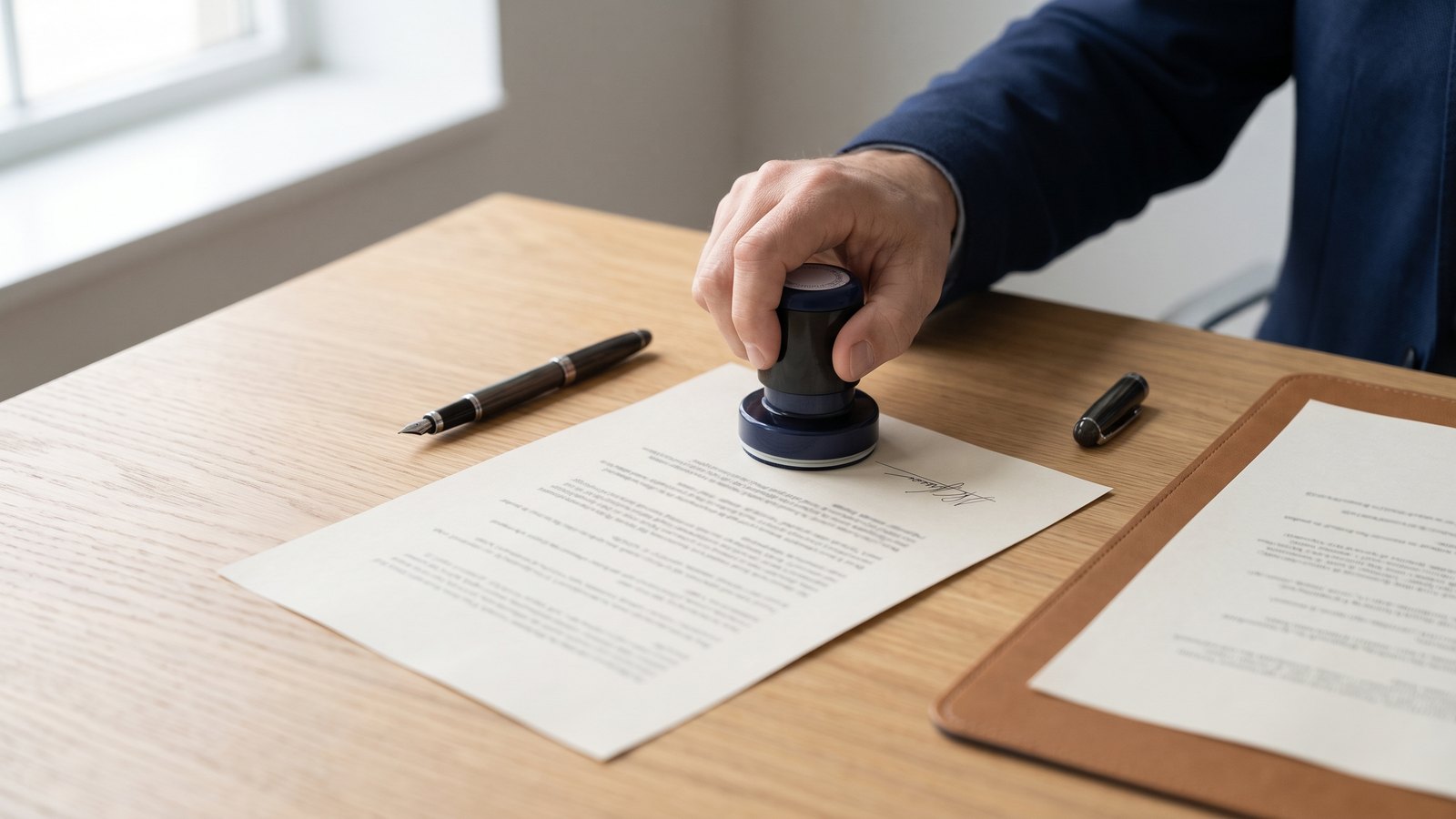
A notarial certificate is the written statement a notary public completes, signs and seals to record a notarization. It states where and when the notarization took place, who appeared before the notary and which notarial act was performed. The Colorado Secretary of State calls the certificate the notary’s “testimony” about the act, and every notarization needs one.
The certificate is not the same as the notary stamp. The stamp is one part of the certificate, next to the wording, the date and the notary’s signature. Without a complete certificate, a notarization can be rejected by the office that receives the document.
This guide explains what a notarial certificate must include, the main types with example wording, when a separate “loose” certificate is used, who is responsible for getting it right, and what a notarial certificate means in the UK.
Key Takeaways
- A notarial certificate is the notary’s written record of a notarization. In Colorado, a certificate “must be used in every notarial transaction” (Colorado Secretary of State).
- It must state the place, the date and the type of notarial act, and carry the notary’s signature, stamp, title and commission expiration date. That date shows when the notary’s commission ends, not how long your document is good for, as we explain in How Long Is a Notarized Document Good For? Florida also requires the type of ID the notary relied on (Fla. Stat. §117.05(4)).
- The main types are the acknowledgment and the jurat. An acknowledgment confirms that you signed willingly. A jurat confirms that you swore or affirmed that the content is true.
- A loose certificate is a separate page attached to the document. Washington law requires it to be “part of, or securely attached to, the record” (RCW 42.45.130(7)).
- The notary is responsible for the accuracy of the certificate. By signing it, the notary certifies that the notarization followed the law (RCW 42.45.130(5)).
- For online notarizations, the certificate must say that audio-video technology was used, under both Florida and Washington law.
What Is a Notarial Certificate?
A notarial certificate is the part of a notarized document where the notary describes what they did. The Colorado Secretary of State defines it as “a written statement of your actions as a notary” and as the notary’s testimony about the type of notarial act completed.
The certificate is usually printed at the end of the document, below the signature lines. A typical example reads: “Subscribed and sworn to before me in the county of Denver, State of Colorado, by John Jones this 10th day of July.” The notary then adds a signature, an official stamp and the commission expiration date.
Washington law states it directly: “A notarial act must be evidenced by a certificate” (RCW 42.45.130). If the certificate is missing, there is no proof that a notarization took place.
What Must a Notarial Certificate Include?
The exact rules come from state law, but the core elements are the same in most states. The Colorado Secretary of State lists these parts:
- Venue: the place of the notarization, including the county, for example “State of Colorado, County of Denver.”
- Date: the date of the notarial act. A notary may not pre-date or post-date a certificate.
- Type of notarial act: an oath or affirmation, an acknowledgment, a witnessed signature or a certified copy.
- The notary’s official signature, matching the signature on file with the state.
- The notary’s stamp, title of office and commission expiration date.
Some states require more. Under Fla. Stat. §117.05(4), a Florida certificate must also name the person whose signature is notarized and state the type of identification the notary relied on.
In addition, it must say whether the signer appeared in person or by audio-video communication. The notary’s name must be typed, printed or stamped below the signature.
Types of Notarial Certificates
Each notarial act has its own certificate wording. Washington’s statute contains short forms that show how the wording differs (RCW 42.45.140):
| Type of certificate | What the signer does | Short-form wording (Washington) |
|---|---|---|
| Acknowledgment | Declares that they signed the document of their own free will | “This record was acknowledged before me on (date) by (name).” |
| Jurat (verification on oath or affirmation) | Swears or affirms that the statement in the document is true | “Signed and sworn to (or affirmed) before me on (date) by (name).” |
| Signature witnessing | Signs the document in front of the notary | “Signed or attested before me on (date) by (name).” |
| Copy certification | Presents a record so the notary can certify a copy | “I certify that this is a true and correct copy of a record in the possession of (name).” |
Every short form also includes the venue, the notary’s signature, stamp, title and commission expiration date.
Acknowledgment vs Jurat
The two certificates you will see most often are the acknowledgment and the jurat. Washington law defines an acknowledgment as a declaration that you signed the record “of the individual’s free will” (RCW 42.45.010). Deeds, powers of attorney and many contracts use an acknowledgment.
A jurat is used when the content must be true, as in an affidavit or a sworn statement. You swear or affirm before the notary, and the person who makes the sworn statement is called the affiant. Our guide to jurat vs acknowledgment explains the difference in detail.
If your document has no certificate and you do not know which type you need, ask the office that will receive it.
What Is a Loose Notarial Certificate?
A loose notarial certificate is a certificate on a separate page that the notary attaches to the document. It is used when the document has no notarial wording, or when the printed wording does not meet the requirements of the state where the notarization takes place.
The attachment must be secure. Under Washington law, a certificate for a paper document “must be part of, or securely attached to, the record” (RCW 42.45.130(7)). For an electronic document, the certificate must be attached to or logically associated with the electronic record.
It is good practice for a loose certificate to identify the document it belongs to, for example by its title, date and number of pages. That makes it harder to move the certificate to a different document.
Who Is Responsible for the Accuracy of a Notarial Certificate?
The notary is responsible for the accuracy of the notarial certificate. Under Washington law, “by executing a certificate of a notarial act, a notarial officer certifies that the officer has complied with the requirements” for that act (RCW 42.45.130(5)).
Two rules follow from that. A notary may not sign a certificate before the notarial act has been performed (RCW 42.45.130(6)). A notary may not pre-date or post-date a certificate either, according to the Colorado Secretary of State.
The signer is responsible for the content of the document itself. The notary confirms who signed and how, not whether the document is correct. Our guide on who can notarize a document covers what notaries do and do not do.
Notarial Certificates in the UK and for Use Abroad
In the UK, “notarial certificate” usually means the certificate a notary public attaches to a document that will be used in another country. According to The Notaries Society, notaries “are primarily concerned with the authentication and certification of signatures, authority and capacity relating to documents for use abroad.”
A notarial certificate for a marriage or birth certificate is a common example. The notary certifies that a copy is a true copy of the original, or confirms a signature, and attaches a certificate stating what was done.
The UK Legalisation Office can then add an apostille, because GOV.UK accepts documents certified by a UK notary or solicitor.
For documents from other countries, the same principle applies. The notarial certificate records the notarization, and an apostille confirms the notary’s signature for use in Hague Convention countries.
Notarial Certificates for Online Notarization
An online notarization ends with a notarial certificate in the same way as an in-person one. The difference is one line: the certificate must say that the signer appeared by audio-video technology.
Florida requires the certificate to state whether the signer appeared “by physical presence or by means of audio-video communication technology” (Fla. Stat. §117.05(4)(c)). Washington requires the certificate to indicate that the notarial act was performed using communication technology (RCW 42.45.130(1)(g)).
With NotaryPublic24 you upload your document and complete a guided identity check, and a Notary Public is appointed to your case. There is no meeting. The notary then completes the notarial certificate with the date, the venue and the type of notarial act. Read more about remote online notarization in the US.
Frequently Asked Questions
Who is responsible for ensuring the notarial certificate is accurate?
The notary public. By signing the certificate, the notary certifies that the notarization met the legal requirements, and the notary may not sign before the act has been performed (RCW 42.45.130). The signer remains responsible for the content of the document.
What are the parts of a notarial certificate?
A notarial certificate has a venue (state and county), the date, a statement of the notarial act with the signer’s name, and the notary’s signature, stamp, title and commission expiration date. Some states, such as Florida, also require the type of ID used and whether the signer appeared in person or online.
What is the venue in a notarial certificate?
The venue is the location where the notarization took place, written as the state and county, for example “State of Florida, County of Miami-Dade.” It shows where the notary was at the time of the notarial act.
When can a loose notarial certificate be used?
A loose certificate is used when the document has no notarial wording, or when the printed wording does not meet the rules of the state where the notarization happens. The certificate must be securely attached to the document.
Is a notarial certificate the same as a notary stamp?
No. The stamp is one part of the certificate. The certificate is the full statement of the notarial act, including the venue, the date, the wording and the notary’s signature.
What is a notarial certificate for a marriage certificate?
It is a certificate a notary attaches to a copy of a marriage certificate to confirm that the copy is true, usually so it can be used abroad. In the UK, the notarized copy can then receive an apostille from the Legalisation Office.