
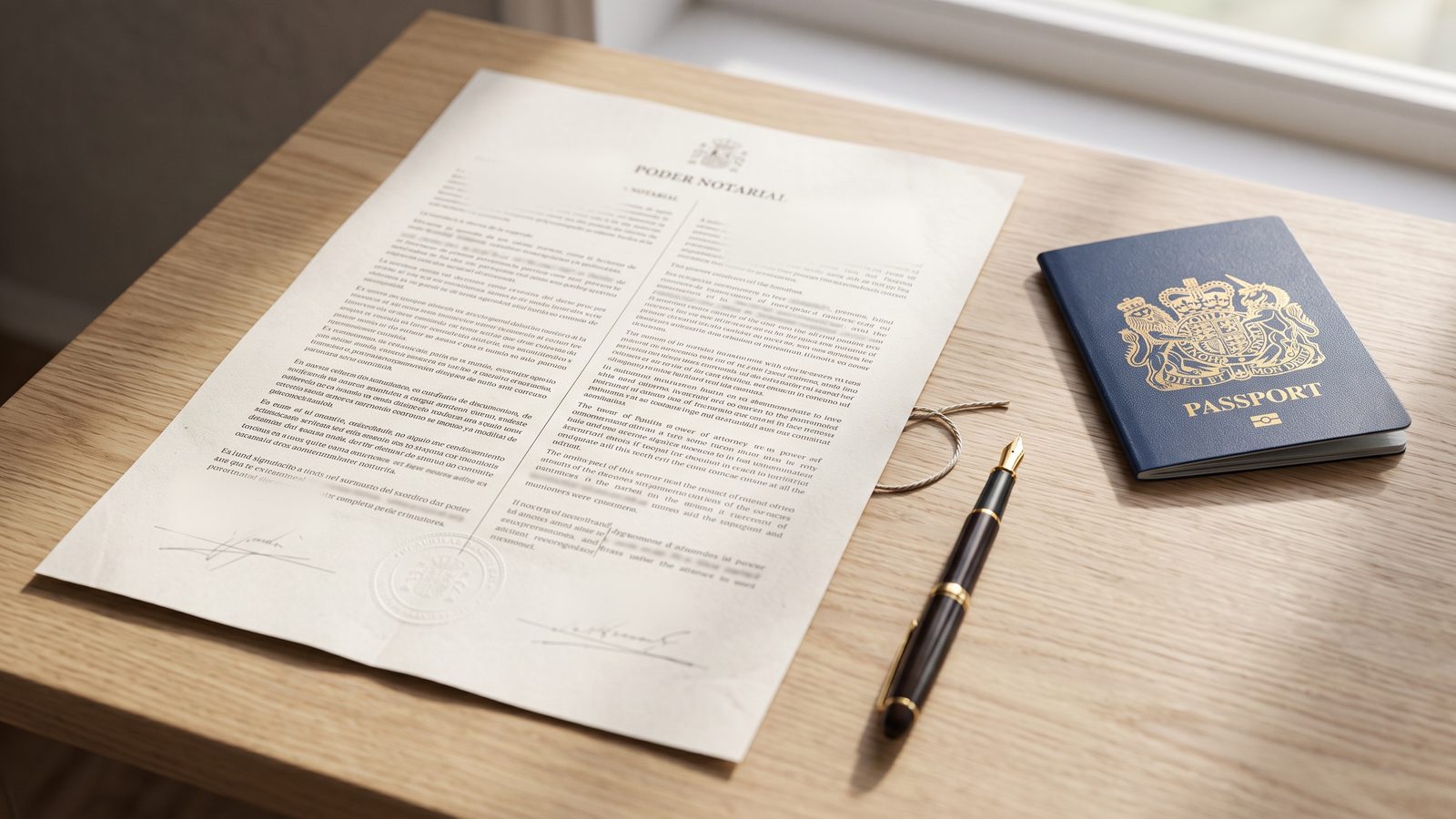
A Spanish power of attorney (poder notarial) lets a lawyer, relative or agent in Spain act for you when you cannot be there yourself. If you live in the UK, you can grant one without travelling: sign it before a UK notary and have it apostilled by the Foreign, Commonwealth and Development Office (FCDO), or sign it in person at the Spanish Consulate in London.
This guide explains when you need a Spanish power of attorney, how the two routes compare, what Spanish law requires for the document to be accepted, and how translation and revocation work.
Key Takeaways
- Spanish law requires a public document. Article 1280 of the Spanish Civil Code says a power of attorney to administer property, or for any act that must be in a notarial deed, must be in a public document.
- Two routes from the UK: a UK notary plus FCDO Apostille (fully remote), or a personal appointment at the Spanish Consulate in London (no apostille or translation needed afterwards).
- A UK notary’s certificate must do more than witness a signature. Spain’s registry directorate accepted a bilingual, apostilled power signed before an English notary in 2017, but rejected one in 2016 where the notary had only certified the signature.
- Use a bilingual text. Spanish notaries and registrars work in Spanish, so a Spanish-English dual-column deed avoids a separate sworn translation.
- The FCDO charges £35 for an e-Apostille (up to 2 working days) and £45 for a paper Apostille (usually up to 25 working days). Ask the Spanish notary which format they accept.
- You can revoke a power at any time by a deed of revocation, including at the Spanish Consulate.
What Is a Spanish Power of Attorney (Poder Notarial)?
A Spanish power of attorney is a notarial deed in which you (the poderdante) authorise one or more people (the apoderado) to act in your name in Spain. Spanish consulates distinguish four types: a general power, which covers most legal and financial matters, a special power limited to specific acts such as one property sale, and general or special powers for lawsuits.
Unlike a UK Lasting Power of Attorney, which is designed for decisions in England and Wales when you lose capacity, a Spanish power is usually granted for a defined purpose while you are fully able to act, and it only works in Spain if it meets Spanish formal requirements. Our power of attorney apostille guide covers the general rules for using a power abroad; this article focuses on Spain.
When UK Residents Need a Spanish Power of Attorney
Under article 1259 of the Spanish Civil Code nobody can contract in another person’s name without authority, and article 1280 lists the acts that must be in a public document, including powers to administer property and any power relating to an act that must be in a notarial deed. In practice, UK residents grant a Spanish power of attorney for:
- Buying or selling a property. The purchase deed (escritura) is signed before a Spanish notary. If you cannot attend, your lawyer signs with a special power. Spanish consulates ask for the property’s registration details when the power is for a sale or purchase.
- Applying for an NIE. The Spanish Consulate in London accepts NIE applications “through a duly accredited representative” if the power of attorney expressly authorises the NIE application and is apostilled; the applicant or the representative must attend in person.
- Bank accounts, mortgages and utilities. Opening or closing accounts, signing a mortgage deed and setting up direct debits for a Spanish property.
- Inheritance. Accepting an inheritance and signing the deed of adjudication when a relative leaves assets in Spain. Under article 1280, renouncing or assigning inheritance rights must also be in a public document.
- Tax and court matters. Representing you before the Spanish tax agency or appointing a lawyer and court agent (procurador) in litigation.
Two Ways to Grant a Spanish Power of Attorney from the UK
| UK notary + FCDO Apostille | Spanish Consulate in London | |
|---|---|---|
| Where you sign | Online meeting or office of a UK Notary Public | In person at the consulate |
| Who drafts the text | Your Spanish lawyer or notary, normally bilingual | Your Spanish lawyer; the consulate accepts a draft or description of the powers |
| Legalisation | FCDO Apostille (e-Apostille £35 or paper £45) | None: the consul acts as a Spanish notary |
| Translation | Not needed if the deed is bilingual; otherwise a sworn translation into Spanish | None |
| Identity documents | Passport (and NIE if you have one) | Valid passport; NIE if you are a foreign national; copy of the agent’s DNI or NIE |
| Timing | Notarisation 2–3 days; e-Apostille up to 2 working days; paper Apostille usually up to 25 working days at the FCDO | Depends on appointment availability; requests go by email |
| Best for | Anyone who cannot get to London or needs a fast turnaround | Those who can attend in person and want a document that works in Spain immediately |
Both routes produce a power that a Spanish notary can rely on. The consular route is simpler on the Spanish side because the consul is a Spanish notarial authority; the UK notary route is the only fully remote option.
Route 1: Sign Before a UK Notary and Apostille It
Step 1: Get the text from your Spanish lawyer
Ask the lawyer or notary in Spain who will use the power to draft it. They know which powers the specific act needs and will normally prepare a Spanish-English dual-column text. Check the names, passport numbers and the exact powers before you sign.
Step 2: Sign before a UK Notary Public
A UK Notary Public verifies your identity, confirms you understand the document and that you are signing voluntarily, and issues a notarial certificate. Make sure the certificate records identification and capacity, not just the signature; this is what Spanish authorities look for when they assess whether the foreign deed is equivalent to a Spanish one. With NotaryPublic24’s UK Notarization you upload the document, verify your identity and meet an appointed UK Notary Public in a short digital meeting, with delivery in 2–3 days.
Step 3: Apostille at the FCDO
Spain and the UK are both parties to the Hague Apostille Convention, and the Spanish Consulate confirms that the apostille is the “exclusive competence of the authorities of the country issuing the document”, so the FCDO is the only body that can apostille a UK-notarised power.
GOV.UK lists a power of attorney among the documents that can be legalised once a UK notary or solicitor has certified it. The paper Apostille costs £45 plus postage and usually takes up to 25 working days; the e-Apostille costs £35, takes up to 2 working days and applies to PDFs electronically signed by a UK notary or solicitor. NotaryPublic24 handles both: UK Paper Apostille (FCDO) with notarisation included, delivered in 4–5 weeks, or UK e-Apostille (FCDO) in 2–3 working days. Confirm with the Spanish notary whether an electronic apostille is acceptable for your deed before choosing.
Step 4: Translate if the deed is not bilingual
If the power is in English only, Spanish authorities will need a Spanish version. Translations by sworn translators appointed by Spain’s Ministry of Foreign Affairs have official status before Spanish courts and administrative bodies. A bilingual deed avoids this step entirely.
Step 5: Send the original to Spain
The apostilled original goes to your lawyer or the person you appointed. For a paper Apostille, use tracked post or courier; for an e-Apostille, the PDF can be emailed.
Route 2: Sign at the Spanish Consulate in London
The consulate states that powers of attorney “may be granted by Spanish or foreign citizens” and that “a personal appearance is always necessary on the day the document is signed”. You bring a valid passport, your NIE if you are a foreign national, a copy of the agent’s DNI or NIE, and a description or draft of the powers to be delegated. The fee varies with the length of the document, the number of principals and the number of copies. Appointment requests and further details are handled by email with the consular office.
A consular power is a Spanish public document, so it needs no apostille or translation. The practical drawbacks are travel to London and waiting for an appointment, so the notary route suits anyone who cannot attend.
Is a UK Power of Attorney Valid in Spain?
A power signed in the UK can be used in Spain, but only if it is equivalent to a Spanish public document. Article 10.11 of the Spanish Civil Code applies Spanish law to a power that will be exercised in Spain, and Spanish notaries and registrars test whether the foreign notary performed a function equivalent to a Spanish notary: identifying the signatory, assessing capacity and authorising the deed.
Two decisions of Spain’s registry directorate (DGRN) show where the line is. In September 2016 it upheld a registrar’s refusal of a power signed in Liverpool because, in the directorate’s words, the English notary had only “legitimised the signature”. In April 2017 it reversed a registrar in Mijas and accepted a bilingual, apostilled power executed before an English notary, holding that the Spanish notary’s statement that the power was sufficient for the deed necessarily includes the judgment that it is equivalent. A registrar who disagrees must give reasons based on the foreign law.
For you this means three things: the UK notary must issue a full notarial certificate, the deed should be bilingual or translated, and the apostille must be attached. A UK Lasting Power of Attorney is a different instrument with its own registration regime; whether a Spanish notary will accept it is a case-by-case equivalence question, and a separate Spanish power removes that uncertainty.
Translation: Bilingual Deed or Sworn Translation
Spanish notaries work from the Spanish text, and in the 2016 case the registrar also objected that the power was not translated or drafted in dual-column form. The simplest solution is a dual-column Spanish-English deed prepared by your Spanish lawyer, signed once before the UK notary.
If you already hold an English-only power, have it translated into Spanish by a sworn translator (traductor-intérprete jurado). Spain’s Ministry of Foreign Affairs publishes the official list through its Oficina de Interpretación de Lenguas, and the translations carry official status before Spanish courts and authorities. If you need the Spanish draft translated into English so you understand what you are signing, NotaryPublic24’s translation service delivers a standard or certified translation in 1–3 days.
How to Revoke a Spanish Power of Attorney
A Spanish power of attorney stays usable until it is revoked, so revoke it formally when you no longer need it. The consulate confirms that powers authorised by a Spanish notary or consul “may be revoked at any time by means of a deed of revocation”, which can be issued at the consular office regardless of where the original was granted. A power granted before a UK notary is revoked by a new deed of revocation, notarised and apostilled in the same way as the original. Tell your agent and the institutions that hold a copy so that nobody continues to act under it.
Frequently Asked Questions
How do I get a power of attorney for Spain from the UK?
Ask your Spanish lawyer to draft the power, then either sign it before a UK Notary Public and have it apostilled by the FCDO, or book a personal appointment at the Spanish Consulate in London. The notary route is fully remote; the consular route needs no apostille or translation.
Is a UK power of attorney valid in Spain?
Yes, if it is a notarial deed that Spanish authorities consider equivalent to a Spanish public document: the UK notary must identify you and confirm capacity, the deed should be bilingual or translated, and it must carry an FCDO Apostille. A power where the notary only witnessed the signature was rejected by Spain’s registry directorate in 2016.
Is a Spanish power of attorney valid in the UK?
A power granted before a Spanish notary or consul is a Spanish public document. To use it in the UK it normally needs a Spanish Apostille and an English translation, and the UK institution receiving it decides whether the powers are sufficient for its purposes. Check with the bank, solicitor or registry before relying on it.
What is a power of attorney in Spanish?
The Spanish term is poder notarial or simply poder. The person granting it is the poderdante and the person appointed is the apoderado. A general power is a poder general and a special power is a poder especial.
How much does a Spanish power of attorney from the UK cost?
The FCDO charges £35 for an e-Apostille and £45 plus postage for a paper Apostille. NotaryPublic24’s UK Notarization costs €109, the UK Paper Apostille with notarisation included €229 and the UK e-Apostille €189. The consulate’s fee depends on the length of the document, the number of principals and the number of copies.
How long does it take?
Online notarisation with NotaryPublic24 takes 2–3 days. The FCDO e-Apostille takes up to 2 working days and the paper Apostille usually up to 25 working days, plus postage to Spain. Consular appointments depend on availability.
How do I cancel a power of attorney in Spain?
Sign a deed of revocation before a Spanish notary, at the Spanish Consulate, or before a UK notary with an apostille, and notify your agent and any bank or authority holding the power. The consulate issues revocations for powers granted before any Spanish notary or consul.