
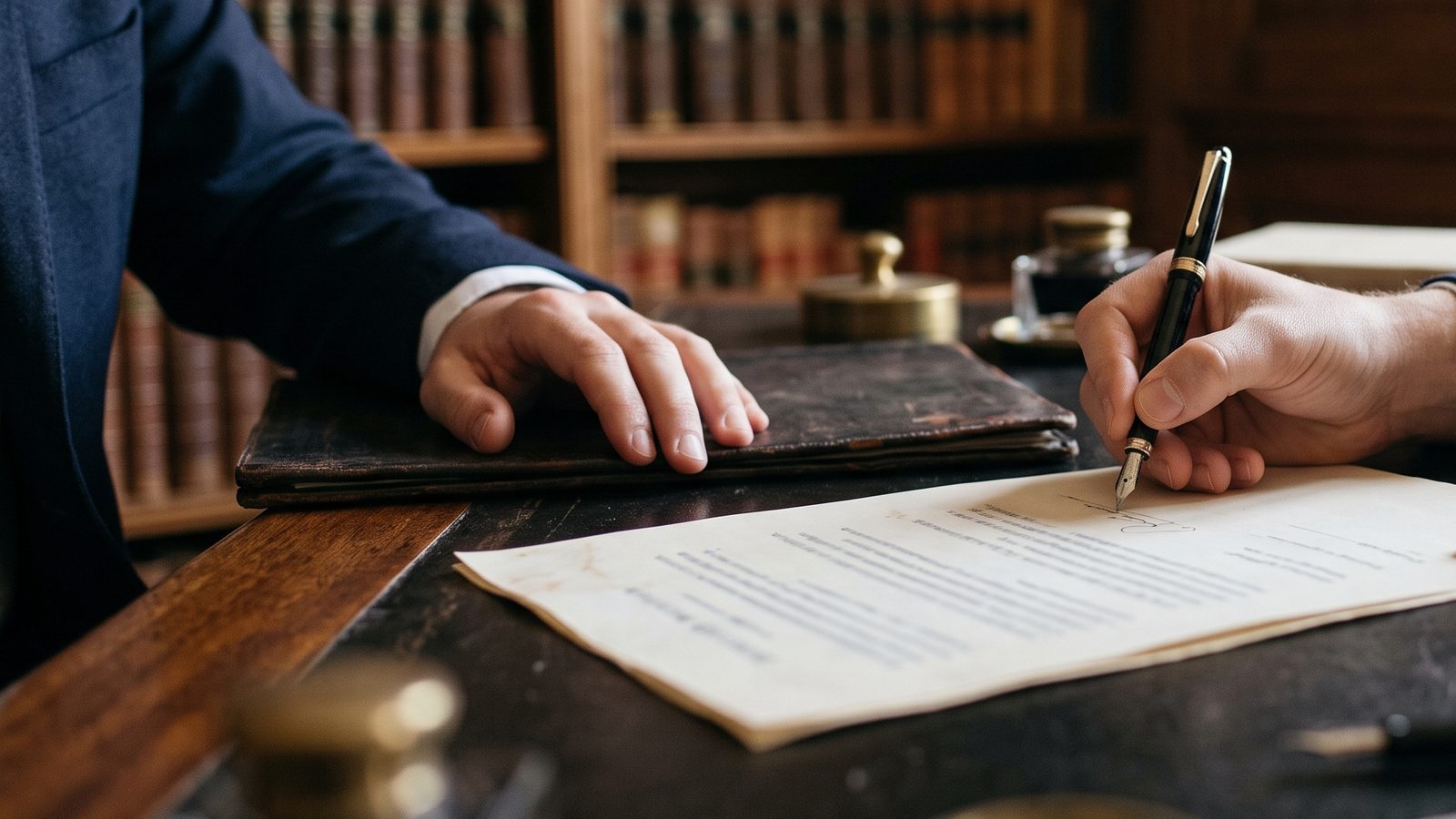
A statutory declaration is a written statement of facts that you formally declare to be true in front of an authorised person, such as a solicitor, a notary public or a commissioner for oaths. In England and Wales it is made under the Statutory Declarations Act 1835.
You use one when an organisation needs formal confirmation of facts and there is no other document that proves them. This guide explains what a statutory declaration is, the wording it must contain, who can witness it, and how it works when the declaration is going abroad.
Key Takeaways
- What it is: a written statement of facts, solemnly declared to be true before an authorised witness under the Statutory Declarations Act 1835.
- Who can witness it: a solicitor, a notary public, a justice of the peace or a commissioner for oaths, among others.
- The wording matters: HM Passport Office rejects a declaration that does not include the statement “I make this solemn declaration conscientiously believing the same to be true”.
- For use in the UK, you make the declaration in person in front of the witness.
- For use abroad, a UK notary public can certify your signature on a written declaration in a short video meeting, if the receiving authority accepts this. The notarial certificate records that you appeared by video.
- A false declaration is a criminal offence under section 5 of the Perjury Act 1911, punishable by up to two years in prison, a fine or both.
What Is a Statutory Declaration?
A statutory declaration is a formal written statement in which you declare that certain facts are true. You sign it in front of a person who is authorised to take declarations, and that person signs it as your witness.
The Statutory Declarations Act 1835 allows a justice of the peace, a notary public or another officer authorised to administer an oath to take the declaration of a person who makes it before them. The declaration is solemn rather than sworn: you do not take an oath, but you confirm that you believe what you have written to be true.
Statutory Declaration, Affidavit or Statement of Truth?
The three documents are easy to confuse, and organisations do not always use the terms precisely. The difference lies in how you confirm the facts and whether a witness is needed.
| Statutory declaration | Affidavit | Statement of truth | |
|---|---|---|---|
| How the facts are confirmed | Solemn declaration under the Statutory Declarations Act 1835 | Sworn on oath or affirmed | Signed statement that you believe the facts are true |
| Witness | Yes, an authorised person | Yes, a person authorised to administer oaths, independent of the parties | Not required |
| Typical use | Evidence of a change of name, HM Land Registry applications, Gender Recognition Certificate applications | Court proceedings where sworn evidence is required | Witness statements in civil cases, HM Land Registry applications |
HM Land Registry has accepted statements of truth as an alternative to statutory declarations since November 2008. A statement of truth does not need to be sworn or witnessed, so check whether it is enough before you book a witness.
You can read more about sworn statements in our guide to affidavit notarisation.
When Do You Need a Statutory Declaration?
You need a statutory declaration when the organisation you are dealing with asks for one. In England and Wales common examples include:
- Changing your name on a passport. HM Passport Office accepts a statutory declaration as evidence of a change of name, provided it is signed in your new name.
- HM Land Registry applications. A statutory declaration or a statement of truth can support an application where title deeds have been lost or destroyed, or a claim based on adverse possession.
- A Gender Recognition Certificate. Applicants make statutory declarations as part of the application.
- Documents for use abroad. Foreign authorities sometimes ask for a written declaration of facts certified by a notary.
Statutory Declaration Wording
The Statutory Declarations Act 1835 sets out the form a declaration must follow. HM Passport Office, for example, rejects a declaration that leaves out the required statement or that is signed only in your old name.
Most declarations use this structure:
I, [full name], of [address], do solemnly and sincerely declare that:
1. [First fact]
2. [Second fact]
And I make this solemn declaration conscientiously believing the same to be true and by virtue of the provisions of the Statutory Declarations Act 1835.
Declared at [place] on [date]
Before me, [name and title of the witness]
Keep each fact short and specific, with dates where you can. Write the declaration in full before your appointment and sign it only when the witness tells you to.
Our Statutory Declaration Form guides you through the wording step by step.
Who Can Witness a Statutory Declaration?
HM Passport Office guidance lists the people who can witness a statutory declaration:
- a solicitor
- a notary public
- a justice of the peace
- a commissioner for oaths
- an officer in the armed forces with the rank of major, lieutenant commander or squadron leader or above
- another person authorised by law to administer an oath
In Scotland, a councillor can also witness a declaration dated on or after 10 December 2007. The witness may charge a fee for the service.
Our guide to the commissioner for oaths explains the role in more detail.
Can You Make a Statutory Declaration Online or by Video?
For use in the UK, no. The Statutory Declarations Act 1835 refers to a declaration made before the person taking it.
The Faculty Office, which regulates notaries in England and Wales, states that its guidance on remote notarisation does not change any legal requirement for a declarant to be physically present.
For use abroad, a video meeting may be possible. A UK notary public may certify that you signed a document while appearing by video.
This is a notarial certificate of your signature, not a statutory declaration made under the 1835 Act.
The notary should take reasonable steps to check that the receiving country accepts it, and the certificate should record that you appeared by video.
With NotaryPublic24 this takes a short digital meeting with an appointed UK Notary Public, usually 5 to 15 minutes. Before you order, confirm with the authority abroad that a notarial certificate based on a video appearance is accepted.
Using a Statutory Declaration Abroad
A foreign authority may want proof that your signature and the person who certified it are genuine. A UK notary provides that proof with a notarial certificate.
In countries that are members of the Hague Apostille Convention, the next step is an Apostille from the Foreign, Commonwealth and Development Office (FCDO). The FCDO can apostille documents certified by a UK notary or solicitor.
Countries outside the convention may require consular legalisation instead, which NotaryPublic24 does not offer.
Read our guide to the UK Apostille for the full process.
What Happens If a Statutory Declaration Is False?
Knowingly making a false statement in a statutory declaration is a criminal offence. Under section 5 of the Perjury Act 1911, the penalty is up to two years in prison, a fine or both.
The witness takes your declaration but does not confirm that the facts are true. You are responsible for the content, so only declare facts you know to be correct.
How NotaryPublic24 Can Help
- Write your declaration: the Statutory Declaration Form produces a correctly worded document that you take to your witness.
- Notarise it for use abroad: UK Notarization connects you with an appointed UK Notary Public in a short digital meeting.
- Add an Apostille: the UK Paper Apostille includes the FCDO fees and tracked post both ways.
Frequently Asked Questions
What is a statutory declaration in the UK?
A statutory declaration is a written statement of facts that you solemnly declare to be true in front of an authorised witness. In England and Wales it is made under the Statutory Declarations Act 1835 and is used when no other document proves the facts.
Can I write my own statutory declaration?
Yes. You can draft the declaration yourself, as long as it contains the wording required by the Statutory Declarations Act 1835 and you make it in front of an authorised witness. The witness confirms that you made the declaration, not that the content is correct.
Who can witness a statutory declaration in the UK?
A solicitor, a notary public, a justice of the peace or a commissioner for oaths can witness a statutory declaration. HM Passport Office also accepts certain armed forces officers and others authorised by law to administer an oath.
Do I need a solicitor for a statutory declaration?
No. A solicitor is one option, but a notary public, a commissioner for oaths or a justice of the peace can also witness your declaration. You do not need a solicitor to draft it either.
Can a family member witness a statutory declaration?
Only if they hold one of the roles authorised to take declarations, such as a solicitor or a notary public. Being related to you does not make someone an authorised witness. If a relative does hold such a role, check with the receiving organisation that it will accept them.
How much does a statutory declaration cost?
The witness may charge a fee for taking your declaration, and HM Passport Office guidance confirms that you pay it. Fees are set by each solicitor, notary or commissioner for oaths, so ask before your appointment.
Can you do a statutory declaration online?
Not for use in the UK, where you make the declaration in front of the witness. For a declaration going abroad, a UK notary public can certify your signature in a video meeting, provided the receiving authority accepts a notarial certificate that records a video appearance.
Is a statutory declaration the same as an affidavit?
No. An affidavit is sworn on oath or affirmed and is mainly used in court proceedings. A statutory declaration is a solemn declaration made under the Statutory Declarations Act 1835 and is used for administrative purposes, such as evidence of a change of name.